

Independent research on the income being built on bitcoin.

Digital credit, digital equity and digital capital, read from the filings for RIAs, family offices and emerging managers. Where the dividend comes from, how far bitcoin can fall before it matters, and when to walk away.

Every figure dated and sourced. Reader-funded, not issuer-sponsored.

Price-yield curves for SATS, SATA and STRC Cash yield falls as purchase price rises; all three curves stay above the long-run U.S. money growth line of about 6.7 percent. $60$80$100$1205%10%15%20%25% U.S. money growth since 1970, about 6.7% a year $100 stated amount SATS 15%SATA 13%STRC 12% Purchase price

A new asset class, built for a new monetary regime

Most clients want a diversified portfolio and income they can live on, and for some, 30 percent or even half of the portfolio is expected to pay. The traditional menu for that money has been thin. In October 2026 the 10-year Treasury yielded about 5.24 percent, and a top-bracket client kept about 3.1 percent after tax.

Meanwhile the dollar has been in structural debasement since the end of the Second World War: the persistent tendency of a highly indebted monetary system to increase nominal claims faster than the supply of genuinely scarce assets. Income that pays less than the growth of money may hold its number and still lose its purchasing power.

Digital credit is the income layer of a new financial stack built on bitcoin: perpetual preferred stock paying 8 to 15 percent on a $100 stated amount, senior to the common, some of it every business day. About $16 billion of it exists. Two years ago none did.
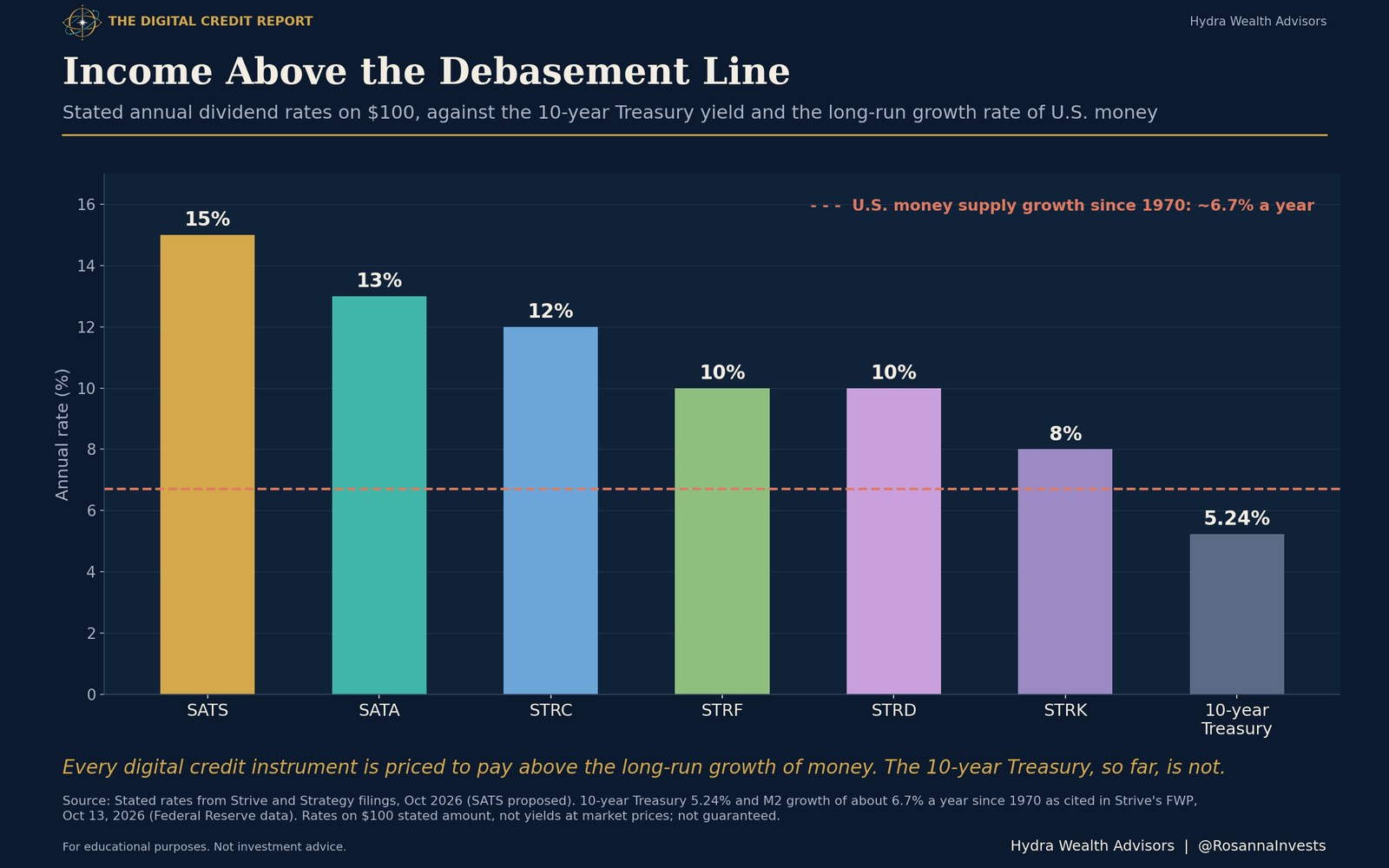
Bar chart: stated rates of SATS 15%, SATA 13%, STRC 12%, STRF and STRD 10%, STRK 8% and the 10-year Treasury at 5.24%, against U.S. money growth of about 6.7% a year
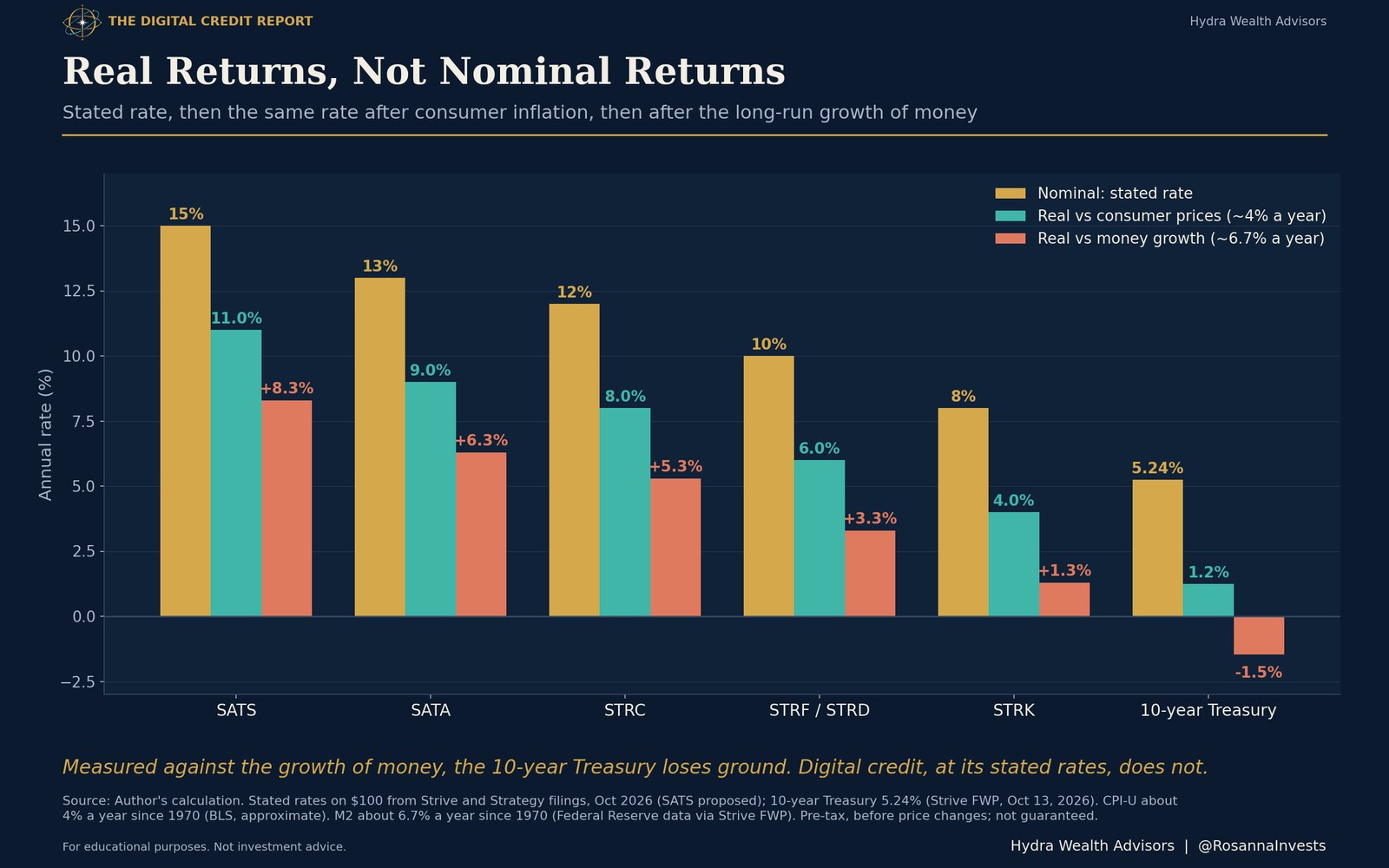
Grouped bars showing each instrument's stated rate, its rate after consumer inflation, and its rate after money growth; the 10-year Treasury turns negative after money growth

Real returns, not nominal returns

The number on the statement is nominal. What it buys is real. Measured against the growth of money, the 10-year Treasury loses ground before tax; digital credit, at its stated rates, clears the line.

InstrumentStated rateAfter money growth
SATS15%+8.3%
SATA13%+6.3%
STRC12%+5.3%
10-year Treasury5.24%−1.5%

Pre-tax, at stated rates on $100, before any change in price. No dividend is guaranteed, and our research is as much about how these instruments can fall as about what they pay.

Run your own numbers

A stated dividend rate, your purchase price, your tax rate and the growth of money. The math behind every yield figure in the report, on your inputs.

Cash yield at your price
15.00%
$15.00 a year per share
Income on your allocation
$37,500
$3,125 a month, before tax
After tax
9.45%
$23,625 a year
Above the growth of money, after tax
+2.75%
What the income keeps in purchasing power
Dividends needed to recover a 10% price drop
8.0 months
At the stated rate, dividends held
Same dollars in the 10-year Treasury
$13,100
a year before tax, 5.24% stated

Digital credit against the Treasury, step by step

SATS10-year Treasury

Illustrative math on stated dividend rates. No dividend is guaranteed; STRC and SATA rates are variable and reset by the issuer. Tax treatment depends on the issuer's earnings and profits and on your situation; confirm with a tax adviser. Price changes are excluded except where shown. Not advice, and not a forecast.

What the research covers

The complete white paper runs an opening chapter, seventeen parts and thirty-one charts, with an executive summary for subscribers. A numbered weekly issue follows every Monday.
Price-yield curves for every digital credit instrument

Price and yield, instrument by instrument

SATA, SATS, STRF, STRC, STRE, STRK and STRD on their own terms, with real price-yield curves.
Bitcoin price at which each instrument stops being fully backed

How far bitcoin can fall

The bitcoin price at which each instrument stops being fully backed, after every claim ahead of it.
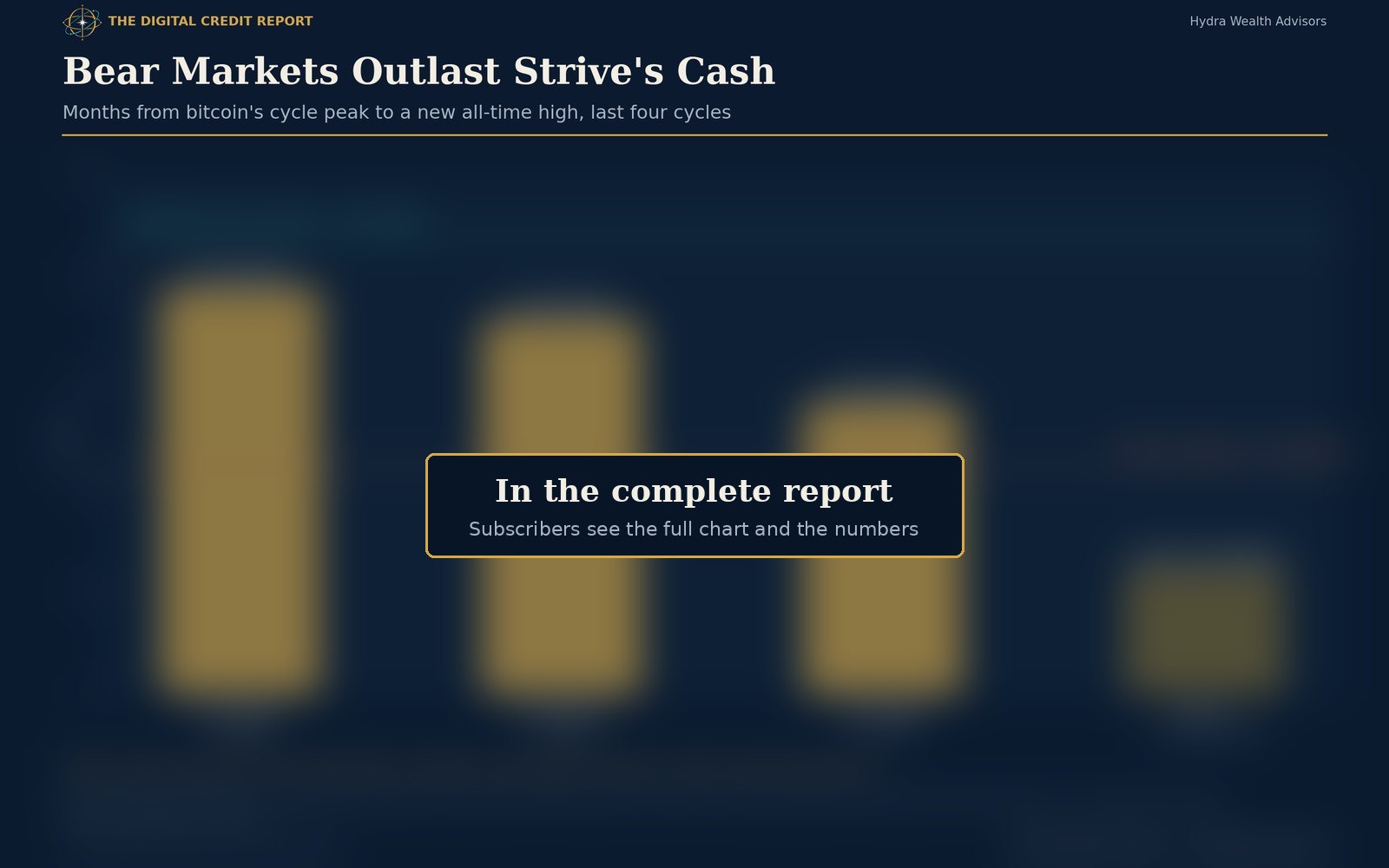
Length of past bitcoin bear markets compared with each issuer's cash runway

What happens in a bear

Stage by stage, with a three-year stress test of whether the dividend continues.

  • How the dividend is actually funded, and what has to keep happening
  • The issuers' record under stress in 2026
  • How digital credit differs from bonds and bank preferreds, with the full risk register
  • Worked tax examples, sizing, IPS and client disclosure language

Start with the free research

The Free Primer

What digital credit is, how it works, where it breaks, and why it matters for advisors and their clients. Eleven pages. Enter your email and we’ll send you a confirmation link. Click it and the primer opens right here on the site.

A Sample Weekly Issue

One complete Monday issue: the scoreboard, the yield table, the backing points and the trigger check.

How far can bitcoin fall before each instrument is impaired

Every bitcoin-backed preferred has a bitcoin price at which it stops being fully backed, after every claim ahead of it and net of the issuer's cash. We call it the backing point. It is the whole risk conversation in one number, and it moves every week as the companies buy bitcoin, issue preferred and spend or rebuild cash. These are the lines on the October filings; subscribers get them every Monday with the trigger check and the runway.

InstrumentSeat in the stackStated rateFully backed down toFall from $81,000
SATSStriveJunior to SATA, ahead of the common. Cumulative.15% fixed$40,400Priced October 15; closes October 20−50%
SATAStriveSenior-most claim; no debt above it. Cumulative, compounding.13% variable$31,800About $23,400 once SATS is issued beneath it−61%
STRDStrategyJunior-most preferred. Non-cumulative: a skipped dividend is gone.10% fixed$17,600−78%
STRKStrategyBehind the converts and the senior preferreds. Cumulative.8% fixed$16,000−80%
STRF · STRC · STREStrategySenior preferreds, on parity with each other, behind about $6.7B of convertible notes. Cumulative.10% · 12% variable · 10% (euro)$14,300−82%

Backing point = (claims senior to and including the instrument, at stated amount, less cash and the dividend reserve) ÷ bitcoin held. Strive from the October 13 filings with SATS as priced ($700 million stated, net proceeds beyond the reserve buying bitcoin); Strategy holdings of October 11 and series sizes from strategy.com on October 16; holdings valued at $82,500 bitcoin on the filings; distances measured from $81,000 on October 18. Price breaks earlier than backing does: in June 2026 the two leading instruments fell 20 to 29 percent below par with coverage still comfortable. Author's calculations at stated rates; not a forecast, not advice.

Questions advisors ask

The short answers. The full thirty-five, with the math, the investment committee memo and the IPS clause, are in The Hard Questions, included with every subscription.

Is bitcoin paying the dividend?
No. Bitcoin pays nothing. The dividend is paid from a cash reserve and from the company issuing more preferred or common stock, with bitcoin sales as the last resort. The bet underneath is that bitcoin appreciates faster than the coupon. That is the sentence to say to every client before the yield.
Isn't paying dividends with new issuance a Ponzi?
A Ponzi has no assets and no disclosed funding. Here the bitcoin pile, the cash reserve and the funding order are all public and filed weekly. The test is two ratios: coverage (bitcoin value over preferred at par) and reserve months. When both are improving the structure is working; when par breaks and the reserve drains, it is running in reverse. We track both for every instrument.
How is this different from a bond?
No maturity, so your exit is selling to someone else. Legally equity, so a missed dividend is a board decision, not a default. Funded by issuance, not cash flow. And every instrument is a claim on one company's pile of one volatile asset. It pays like high-yield credit and should be sized like crypto.
Does it replace the bond allocation?
No. In the June 2026 drawdown the leading instruments fell 20 to 29 percent below par in the same week equities fell. Ballast it is not. It can sit next to the income core as a higher-yielding satellite, counted against the client's bitcoin exposure.
Bitcoin is volatile. How far can it fall before this is impaired?
Each instrument has its own line. Net of the issuer's cash and after every claim ahead of it, SATS is fully backed down to about $40,400 bitcoin and SATA to about $31,800 today (about $23,400 once SATS sits beneath it); Strategy's most junior series, STRD, to about $17,600. From $81,000 those are falls of 50 to 82 percent; the table above has every series. On the bitcoin alone, with no credit for cash, the lines are tighter: Strive's whole preferred stack is covered down to a fall of about 38 percent once SATS is issued. The market prices the break earlier than the math does, which is what June showed.
Is my $100 safe?
No one guarantees it. On the variable-rate series the issuer defends par by raising the rate and buying back shares; on the fixed-rate series there is no defense at all. Par is the ceiling: buy below it, expect a break in every bitcoin drawdown, and hold only what you can carry through one.
What about taxes?
Both issuers expect distributions to be treated as return of capital to the extent they are not paid from earnings and profits, which both issuers have said they expect to be limited. That is a materially different after-tax outcome for a taxable client, and no advantage at all in a tax-exempt account. Model both cases with the client's tax adviser every year.
Who should not own it?
Anyone who heard "13 percent paid daily" and nothing else. Anyone who needs the income to be stable in the week their equities fall. Anyone holding it in a tax-exempt account as a bond substitute. And any client whose adviser has not read the series terms.
Get all thirty-five with a subscription

Includes the memo template, the IPS clause and the client script.

Plans

Subscriber

$199 a month or $1,990 a year
Founding rate through February 1, 2027
$149 a month
or $1,490 a year, billed quarterly
  • The complete white paper and executive summary
  • Weekly issue every Monday, with the archive
  • The monthly regime note: money growth, real rates, the dollar and bitcoin, tied to the instruments
  • Four quarterly briefings
Subscribe

Firm License

From $4,995 a year
Founding rate through February 1, 2027
from $3,495 a year
Priced by team size. Up to five advisors at the starting rate; larger teams by quote.
  • Everything in Subscriber, for your team
  • A co-branded, client-ready paper
  • Client distribution rights
  • Quarterly refresh and a briefing call
License your firm

Funds and allocators

Weekly data file and direct questions.
  • Coverage and data by request
Contact us

The founding rate is available through February 1, 2027. After that date the full price applies. Annual plans are billed in quarterly installments. Card payments are processed by Stripe and subscriptions can be canceled at any time from your account. Subscription Terms. Already a subscriber? Sign in.

The Digital Credit Report is published by Hydra Wealth Advisors LLC, an investment adviser registered with the State of New York; registration does not imply a certain level of skill or training. Research publications are impersonal and are not advice tailored to any reader; subscribers are not advisory clients. Nothing in this publication is paid for by any issuer. The author may hold positions in securities discussed, as disclosed in each issue. Stated dividend rates are not guaranteed, and past results do not guarantee future results. Form ADV Part 2A and Part 2B are available here and on request.